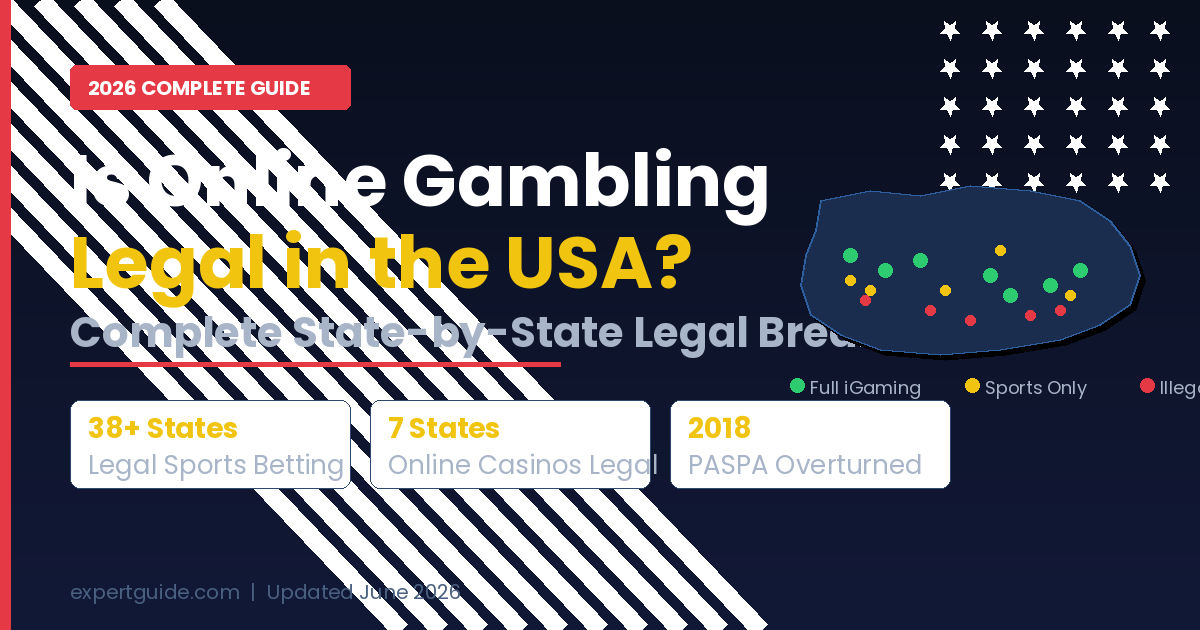
Online gambling is legal in the USA — but only in specific states, and the rules vary dramatically depending on where you live. Federally, no law bans individual players from gambling online. What actually determines your rights is your state’s legislation. Right now, seven states offer fully licensed online casinos, and more than 38 permit online sports betting. This guide breaks down every major state so you know exactly where you stand before placing a bet.
What Does Federal Law Actually Say About Online Gambling?
Federal law does not make it illegal for individual Americans to gamble online. The two major laws — the Wire Act of 1961 and the Unlawful Internet Gambling Enforcement Act (UIGEA) of 2006 — target operators and payment processors, not the bettors themselves.
The Wire Act was long interpreted as banning all interstate online gambling. A 2011 Department of Justice opinion changed that, clarifying it applies only to sports betting wire transmissions. UIGEA restricts banks from processing payments to unlicensed gambling sites, but players aren’t the target.
The real turning point came in May 2018, when the Supreme Court struck down the Professional and Amateur Sports Protection Act (PASPA) in Murphy v. National Collegiate Athletic Association. That decision gave every state the authority to legalize sports betting independently.
Bottom line: federal law doesn’t criminalize online betting for players. Your state law is what actually matters.
Which States Have Fully Legal Online Casinos in 2026?
Seven states have legalized full online casino gaming (iGaming) as of 2026. Nevada operates a separate online poker-only market.
| State | Online Casino | Online Sports Betting | Legal Since |
|---|---|---|---|
| New Jersey | Yes | Yes | 2013 / 2018 |
| Delaware | Yes | Yes | 2013 / 2018 |
| Pennsylvania | Yes | Yes | 2019 / 2019 |
| Michigan | Yes | Yes | 2021 / 2020 |
| West Virginia | Yes | Yes | 2021 / 2018 |
| Connecticut | Yes | Yes | 2021 / 2021 |
| Rhode Island | Yes | Yes | 2023 / 2022 |
| Nevada | Poker Only | Yes | 2013 / 2018 |
| New York | No | Yes | — / 2022 |
| California | No | No | — / — |
| Texas | No | No | — / — |
| Florida | No | Limited (Tribal) | — / 2023 |
Every other state either prohibits online casino gaming or has no law specifically addressing it.
State-by-State Breakdown: Where Can You Legally Gamble Online?
New Jersey is the gold standard. NJ launched online casino gaming in 2013 and has generated over $6.3 billion in cumulative iGaming revenue through 2025, according to the New Jersey Division of Gaming Enforcement. More than 30 licensed apps operate here — BetMGM, DraftKings, Caesars, FanDuel, and others.
Pennsylvania launched in 2019 and became the second-largest iGaming market almost immediately. The Pennsylvania Gaming Control Board reported monthly online casino revenue regularly exceeding $200 million in 2024 and 2025.
Michigan went live in January 2021. The Michigan Gaming Control Board reported over $2 billion in annual online casino revenue for 2024, with growth continuing year-over-year.
Connecticut operates with just two licensed providers: DraftKings (partnered with Mohegan Sun) and FanDuel (partnered with Foxwoods). The limited competition means fewer promotions than NJ or PA.
Delaware was technically first to legalize in 2013 but remains the smallest market. Three sites operate under state lottery oversight with limited game variety.
West Virginia is legal but thin. DraftKings and BetMGM operate here; expect fewer game options than larger markets.
Rhode Island is the newest market, launching in March 2023 through Bally’s as the sole licensed operator — the most restricted setup of any legal iGaming state.
Nevada offers online poker only through licensed rooms like WSOP.com and BetMGM Poker. No online slots, blackjack, or roulette are available.
States With Legal Online Sports Betting Only
More than 38 states and Washington D.C. have legalized online sports betting as of June 2026. The most significant:
- New York — Launched January 2022. Generated over $2.1 billion in sports betting handle in its first full calendar year (New York State Gaming Commission, 2023).
- Arizona — Active since September 2021, with over a dozen licensed operators.
- Colorado — Launched May 2020, among the earliest post-PASPA markets.
- Illinois — Removed its in-person registration requirement in 2022, opening the market significantly.
- Tennessee — Online-only model with no retail sportsbooks.
- Virginia — Launched 2021, now home to FanDuel, DraftKings, BetMGM, and Fanatics.
States Where Online Gambling Is Still Illegal
California is the biggest holdout. Despite its 39 million residents and enormous potential tax revenue, multiple ballot initiatives have failed due to conflict between card rooms and tribal gaming operators. No legal online gambling of any kind exists as of mid-2026.
Texas has seen repeated legislative attempts that stall in committee. Online gambling advocates have gained little ground against strong opposition in the legislature.
Florida is complicated. The Seminole Tribe’s Hard Rock Bet app launched in 2023 following years of legal battles, but only tribal entities operate legally. Non-tribal online gambling remains prohibited.
Georgia has come close legislatively but hasn’t crossed the finish line. Bills have passed committee hearings multiple times without becoming law.
Common Myths About US Online Gambling Laws
Myth: Using a VPN makes offshore gambling legal.
A VPN changes your visible IP address — it doesn’t change your legal jurisdiction. If online gambling is illegal in your state, accessing offshore sites through a VPN is still illegal under state law. Worse, those sites carry no regulatory protection. If something goes wrong with a payout, there’s no gaming commission to call.
Myth: Popular offshore sites are safe.
Popularity doesn’t equal accountability. Offshore sites aren’t licensed by any US state, which means no consumer protection, no regulated dispute process, and no guaranteed payouts. Several well-known offshore platforms have disappeared without warning, taking player balances with them.
Myth: All states will legalize gambling soon.
The trend toward legalization is real, but it’s not inevitable everywhere. California and Texas — the two largest states by population — face structural political opposition with no clear path to legalization within the next two to three years. Most gaming analysts don’t expect either state before 2028 at earliest.
Myth: Winning on offshore sites means no taxes.
The IRS taxes all gambling winnings regardless of where the gambling took place. Playing on an unlicensed offshore site doesn’t exempt winnings from federal income tax. Licensed US sites issue W-2G forms for large wins; offshore sites don’t — but the obligation still exists.
Frequently Asked Questions
Is online gambling illegal in the United States?
Not uniformly. Federal law doesn’t ban individual players from gambling online — it targets operators and payment processors. Whether it’s legal for you depends on your state. Seven states have fully licensed online casinos; more than 38 have legal sports betting. In states without legal frameworks, using offshore sites exists in a legal gray zone for players.
Can I get in trouble for gambling on offshore sites?
States rarely prosecute individual players for using offshore gambling sites. The practical risk isn’t legal — it’s financial. Offshore sites operate without regulatory oversight, which means no guaranteed payouts, no dispute resolution, and no recourse if the site shuts down with your funds.
Which state has the best legal online gambling options?
New Jersey has the most competitive and mature iGaming market in the country — the most licensed operators, the broadest game selection, and the most frequent promotional offers. Pennsylvania and Michigan are strong alternatives for residents there.
Do I owe taxes on online gambling winnings?
Yes. The IRS treats all gambling winnings as taxable income. You’re required to report them on your federal return regardless of where you won. Licensed US sites issue W-2G forms for winnings over reporting thresholds; offshore sites don’t, but the tax obligation remains the same.
Can I use a VPN to gamble in restricted states?
Technically possible, but legally questionable and practically risky. Licensed operators use GPS geolocation verification, not just IP checks. If they detect location spoofing, they can void your account and withhold winnings. For unlicensed sites, a VPN offers no legal protection.
Is online poker legal in the USA?
Online poker is fully legal in Nevada, New Jersey, Michigan, Pennsylvania, Delaware, West Virginia, and Connecticut. Nevada allows poker only — no other casino games. Multi-state networks like WSOP.com connect players across several of these states into shared poker pools.
When will California legalize online gambling?
No firm timeline. Disagreements between tribal gaming operators and commercial card rooms have blocked every major legislative and ballot initiative. Most analysts place California legalization no earlier than 2028 given the current political landscape.
What should I look for in a licensed online gambling site?
Verify the site holds a license from your state’s gaming commission (NJ Division of Gaming Enforcement, Pennsylvania Gaming Control Board, Michigan Gaming Control Board, etc.). Licensed sites display their license number prominently. If you can’t verify a license, that’s a clear sign to avoid the platform.
The Bottom Line
Online gambling in the USA is legal, regulated, and growing — but only where your state has explicitly authorized it. Seven states offer full online casino access, sports betting is legal in more than 38 states, and the map continues to expand.
If legal options exist where you live, use them. Licensed platforms protect your money, pay out reliably, and give you real recourse when something goes wrong. Check your state gaming commission’s website directly for the most current list of approved operators before you deposit anything.
If your state hasn’t legalized yet, the honest advice is to wait. Offshore alternatives look appealing but carry real financial risk that licensed sites simply don’t.
Explore fresh content that brings real value —start reading and stay ahead of the curve