Every year, roughly 2 million Americans develop a severe gambling disorder, according to the National Council on Problem Gambling (NCPG). Most don’t seek help until they have lost far more than money — marriages, savings, careers, and self-worth disappear with it. This article covers what gambling addiction recovery actually looks like, the real steps that produce results, and firsthand accounts from people across the USA who rebuilt their lives from the lowest points imaginable.
What Is Gambling Addiction and Why Is It So Hard to Quit?
Gambling addiction — clinically called Gambling Disorder — is a behavioral addiction recognized by the American Psychiatric Association (APA) in the DSM-5. It triggers the same dopamine reward pathways in the brain as substance addictions, which is why willpower alone rarely works.
The brain adapts over time. A gambler needs bigger bets, longer sessions, or higher stakes to feel the same rush that a $20 bet once provided. That escalation creates neurological dependency, not just a bad habit. The American Journal of Psychiatry describes this as a chronic, relapsing brain condition that requires structured intervention — not moral correction.
The National Institutes of Health (NIH) reports that approximately 1 in 5 people with Gambling Disorder attempt suicide. That number reflects the weight of shame, secrecy, and financial ruin that the disorder piles on top of itself. Understanding the neuroscience removes the blame and opens the door to actual treatment.
Signs you or someone you love may have a Gambling Disorder:
- Gambling with increasing amounts of money to achieve the same excitement
- Repeated failed attempts to cut back or stop
- Lying to family members about gambling behavior
- Relying on others to cover gambling-related financial losses
- Experiencing restlessness or irritability when trying to reduce gambling
How Does Gambling Addiction Recovery Work? (Step-by-Step)
Effective gambling addiction recovery requires three components working together: acknowledgment, structured support, and long-term relapse prevention. Completing only one or two of these is the most common reason early recovery fails.
Step 1: Acknowledge the Problem and Reach Out
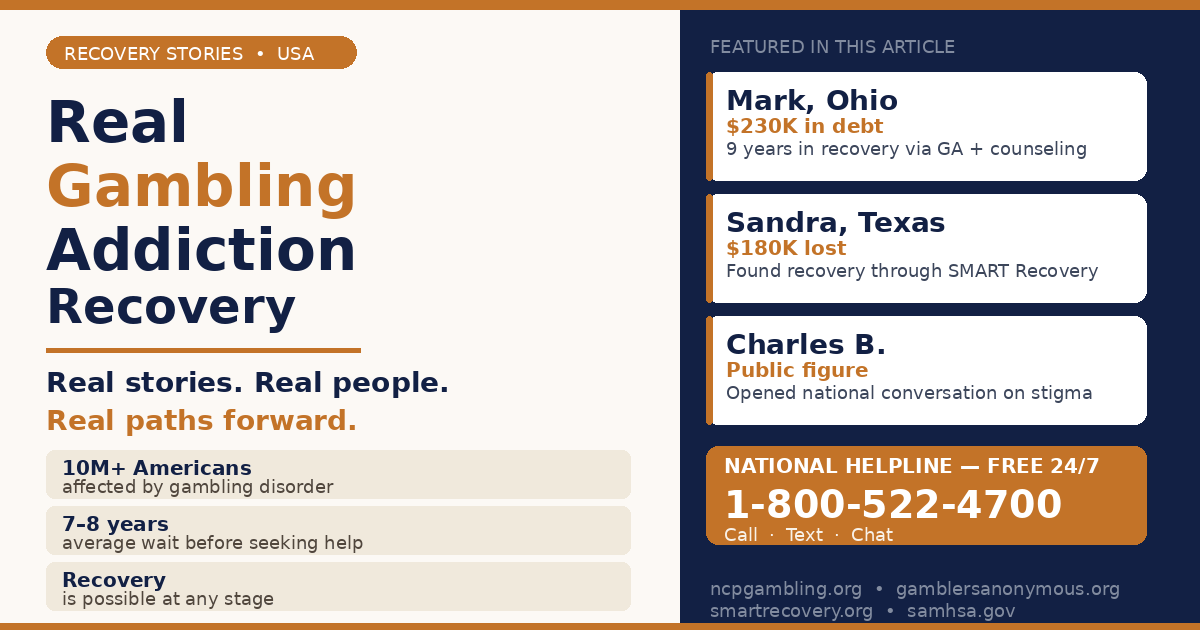
The NCPG Helpline (1-800-522-4700) connects callers with trained counselors around the clock. Most people who call describe immediate relief — simply naming the problem out loud, to someone who doesn’t judge, begins the process. The helpline also provides referrals to local treatment options.
Step 2: Remove Access to Gambling
Relying on restraint inside an environment of access rarely works. Most states run voluntary self-exclusion programs — a legal mechanism that bars you from casinos, racetracks, and online platforms. As of 2025, all 50 states with commercial or tribal casinos offer some form of self-exclusion. Apps like Gamban block gambling sites on every device simultaneously and are widely used in early recovery.
Step 3: Enter Professional Treatment
Cognitive Behavioral Therapy (CBT) has the strongest research base for Gambling Disorder. A study published in Psychological Medicine found that CBT reduced gambling frequency in 80% of participants over a 12-month period. CBT targets specific thought patterns that drive gambling — the gambler’s fallacy, near-miss distortions, and superstitious thinking — and replaces them with rational responses.
Motivational Interviewing (MI) is commonly used alongside CBT in outpatient settings. For severe cases, residential treatment programs provide 24/7 structure during the highest-risk early weeks.
Step 4: Join a Peer Support Network
Gamblers Anonymous (GA) operates more than 2,000 chapters across the USA. The 12-step model creates accountability and community. Many recovering gamblers credit GA with providing what therapy alone could not: a room full of people who understood the exact thoughts running through their heads — because they had the same ones.
Step 5: Address the Financial Damage Directly
Debt is both a cause and consequence of gambling addiction. Unresolved financial stress becomes a chronic relapse trigger. The National Foundation for Credit Counseling (NFCC) offers free consultations and debt management planning. A financial therapist — a hybrid of financial planning and mental health counseling — can help rebuild money habits without the shame spiral that traditional financial advice often triggers.
Step 6: Build a Relapse Prevention Plan
Identify specific triggers (stress at work, boredom, sports events), map out what to do when a craving hits, and establish who to call. This plan should be written, specific, and reviewed regularly with a therapist or sponsor. Recovery plans that live only in a person’s head tend to evaporate under pressure.
Real Recovery Stories from the USA
These accounts come from individuals who shared their stories publicly through NCPG media campaigns, GA published testimonials, and documented interviews.
Mark, 44 — Phoenix, Arizona
Mark started gambling at 22 with $20 scratch tickets from a gas station. By 38, he had emptied his retirement account and borrowed $80,000 from family members, most of whom didn’t know the full extent of what was happening. He entered residential treatment at a facility in Scottsdale after his wife gave him a final ultimatum.
“The first 90 days were brutal,” he told the NCPG. “But they were also the most honest I’d been in 15 years.” The residential program combined individual CBT with group therapy and daily GA meetings. Mark has been gambling-free for six years. He now runs a peer support group in Phoenix and credits the financial counseling he received as the piece that made recovery sustainable — because addressing the debt removed the shame that had always pushed him back to the casino.
Sandra, 31 — Chicago, Illinois
Sandra’s addiction centered on online poker. She estimated losing $140,000 over four years while maintaining a full-time career in marketing. Nobody at work knew. She filed late tax returns, missed rent payments, and borrowed from her 401(k) — all while presenting as completely functional.
She entered outpatient CBT through a Chicago-based behavioral health clinic in 2021 after a mental health crisis forced her to tell her sister the truth. “Saying it out loud to another person was the hardest thing I’ve ever done,” she said in a public testimonial. Sandra is now three years into recovery and actively advocates for insurance companies to cover Gambling Disorder treatment at parity with substance addiction — because her first insurer initially denied her claim.
Derek, 57 — Orlando, Florida
Derek had gambled casually for decades — weekend trips to Biloxi, a few hundred dollars here and there. Slot machines took over at 50. Within three years, he had withdrawn $230,000 from joint savings without his wife’s knowledge. She discovered it when they tried to refinance their home.
Derek attended GA for three years before finding stable ground. “GA gave me language for what was happening inside my head,” he said in a recorded group testimony. “I stopped feeling like a moral failure and started treating this like the disease it is.” He credits consistent attendance — not just attending when things felt bad — as what ultimately held his recovery together.
Lisa, 39 — Nashville, Tennessee
Lisa’s story is less common but increasingly recognized: she developed a gambling problem through online sports betting after Tennessee legalized mobile wagering in 2020. Within 18 months, she had placed over $200,000 in bets and had lost roughly $80,000 net. The speed at which mobile betting consumed her surprised even her treatment team.
She accessed treatment through Tennessee’s Problem Gambling Helpline and received CBT combined with medication for co-occurring anxiety. “The anxiety and the gambling were feeding each other,” she said. “Treating one without the other would not have worked.” Lisa has been gambling-free for two years and has spoken at state legislative hearings about mobile gambling regulation.
Common Mistakes That Derail Gambling Recovery
Most relapses don’t happen because a person is weak. They happen because early recovery is built on incomplete strategies that leave the core vulnerabilities untouched.
Attempting recovery alone
Isolation is a defining feature of Gambling Disorder — most people hide the addiction for years before addressing it. Attempting recovery without outside accountability leaves the same environment that enabled the addiction completely intact.
Ignoring the financial stress
Unpaid debts create a constant state of low-grade anxiety, which is one of the most reliable relapse triggers documented in addiction research. Addressing the finances as part of treatment — not afterward, when a person feels “ready” — significantly improves long-term outcomes.
Substituting one compulsion for another
Cross-addiction is well-documented. People in early gambling recovery sometimes shift to alcohol, online gaming, compulsive spending, or even work addiction. These are not signs of recovery — they are the same underlying need wearing different clothes. Good treatment plans anticipate this and address the emotional drivers, not just the behavior.
Treating it as a willpower problem
The APA classifies Gambling Disorder as a medical condition. Framing it as a character flaw delays treatment, compounds shame, and predicts relapse. People who understand the neurological basis — and stop attributing it to personal weakness — consistently report better treatment engagement and longer-term recovery.
Stopping support after initial treatment
A 2020 analysis published in Addictive Behaviors found that sustained recovery from Gambling Disorder required ongoing support for a minimum of two years post-treatment. Completing an initial treatment program and disappearing from all support structures is the most documented precursor to full relapse.
Frequently Asked Questions About Gambling Addiction Recovery
Can someone fully recover from gambling addiction?
Yes, and it happens regularly. The American Psychiatric Association confirms that many people with Gambling Disorder achieve long-term remission with appropriate treatment. Recovery means maintaining a gambling-free life, rebuilding relationships, and stabilizing finances — and thousands of Americans have done exactly that. Full recovery is not just possible; it is the expected outcome with consistent, properly structured support.
How long does gambling addiction recovery take?
The first 6 to 12 months carry the highest relapse risk. Meaningful stabilization — where cravings decrease and daily functioning normalizes — typically occurs within the first year. Most clinicians who specialize in behavioral addictions describe long-term recovery as an ongoing process, not a fixed endpoint. People in GA often describe it as a permanent commitment to a new way of living.
What is the most effective treatment for gambling addiction?
Cognitive Behavioral Therapy (CBT) has the strongest evidence base. It directly targets the thought patterns — gambler’s fallacy, near-miss effect, and illusion of control — that maintain gambling behavior. Most successful treatment programs layer CBT with financial counseling and ongoing peer support through GA or similar groups. No single approach works in isolation for most people.
Is there medication for gambling addiction?
No medication has received FDA approval specifically for Gambling Disorder. However, naltrexone (an opioid antagonist used for alcohol use disorder) has shown measurable effectiveness in clinical trials for reducing gambling urges. Some antidepressants are prescribed when co-occurring depression or OCD contributes to the behavior. All medication decisions require evaluation by a licensed psychiatrist.
What should I do if a family member has a gambling problem?
Call the NCPG Helpline at 1-800-522-4700. Gam-Anon is a peer support group for family members and friends of people with gambling problems, with chapters across the USA. Avoid covering gambling debts — even once — as this reliably delays the person seeking treatment. Hold firm boundaries while maintaining emotional availability.
How common is gambling addiction in the USA?
The NCPG estimates that 2 million U.S. adults meet clinical criteria for severe Gambling Disorder each year. An additional 4 to 6 million are classified as problem gamblers with significant harm but not full diagnostic criteria. Since 2018, when the Supreme Court opened the door to state-level sports betting legalization, those numbers have grown — and the rate of mobile-specific gambling problems has accelerated sharply.
Does health insurance cover gambling addiction treatment?
Coverage varies. Under the Mental Health Parity and Addiction Equity Act (MHPAEA), insurance plans that cover mental health must provide comparable coverage for gambling disorder treatment. In practice, getting coverage often requires a formal diagnosis code and documentation. A treatment center’s billing team can help navigate the claims process and appeal denials.
What makes Gamblers Anonymous effective?
GA provides consistent community accountability and a structured framework for understanding addiction. While controlled studies are limited by the anonymous nature of membership, large-scale participant surveys consistently show that regular GA attendance reduces gambling frequency significantly. Long-term recovering gamblers frequently cite GA as the most sustained and accessible support they received throughout recovery.
The Path Forward Is Real
Gambling addiction destroys quietly — and recovery rebuilds the same way, one decision at a time. The stories above are not rare exceptions. Hundreds of thousands of Americans have come back from financial ruin, broken relationships, and psychological collapse to build stable, full lives.
The single most important next step is telling someone who can help. Call the NCPG Helpline at 1-800-522-4700, find a local GA meeting at gamblersanonymous.org, or ask a doctor for a referral to a CBT-trained therapist. Recovery is not a question of character — it is a question of getting the right structure around a brain condition that cannot be thought or willed away on its own.
Get inspired by thought-provoking articles—find fresh insights and actionable tips you can use