A gambler can win for a week, a month, even a year. The math behind gambling guarantees that over enough bets, the casino, sportsbook, or lottery still comes out ahead. This article breaks down exactly why, using house edge, expected value, variance, and real game data, so you can see the numbers instead of the myths. If you’re trying to cut back or quit, understanding this math is one of the most useful tools you have, because it explains why no streak, system, or strategy changes the outcome over time.
What Is House Edge and Why It Guarantees Long-Term Losses?
House edge is the built-in percentage advantage a casino or betting operator holds over every player on every bet. It’s calculated directly into the rules and payout odds of the game, so it applies whether you’re on a hot streak or a cold one. Over thousands of bets, that small percentage turns into a near-certain loss.
Take American roulette. The wheel has 38 numbers, but a straight-up bet only pays out 35 to 1. That gap between true odds and actual payout is the house edge, and it sits at 5.26% on every single spin, regardless of which number you choose or how many times you’ve played that night.
The casino doesn’t need to win every hand. It only needs that small percentage edge repeated across millions of bets from millions of players. The law of large numbers does the rest, smoothing out short-term luck until the edge dominates the results and the casino’s actual revenue lines up almost exactly with the math on paper.
This is why “beating the house” on a single night doesn’t disprove the math. One spin, one hand, or one bet can break either way, and short sessions are full of noise. The edge only shows itself once you zoom out to hundreds or thousands of bets, which is exactly how casinos plan their business and forecast their revenue each quarter.
Return to player (RTP) is the inverse way of expressing the same number. A slot machine advertised at 96% RTP has a 4% house edge. Both numbers describe the identical mathematical relationship, just framed from opposite sides of the bet.
How Expected Value Determines Every Bet You Make
Expected value (EV) tells you the average result of a bet if you repeated it thousands of times. It’s calculated as: (probability of winning x payout) minus (probability of losing x amount wagered). A negative EV means you lose money on average, even though individual bets can still win.
Here’s the math for a single number bet in American roulette, using a $1 wager:
- Probability of winning: 1/38 (about 2.63%)
- Payout if you win: $35
- Probability of losing: 37/38 (about 97.37%)
- EV calculation: (0.0263 x $35) – (0.9737 x $1) = $0.92 – $0.97 = -$0.05
That negative five cents per dollar wagered is the house edge in action. It doesn’t matter if you bet red, black, odd, even, or a single number. Every bet type on that wheel carries the same built-in loss per dollar, just distributed differently across wins and losses.
This is the part most betting systems ignore. Martingale, Fibonacci, and other progressive betting strategies change how you size your bets after a win or loss, but they cannot change the negative expected value of the underlying game. You’re still betting into the same -5.26% edge; you’re just betting different amounts at different times, and a long enough losing streak under Martingale can wipe out a bankroll faster than flat betting would.
The table below shows how that -$0.05 EV per dollar compounds as bet count increases, assuming flat $1 bets on a single number:
| Number of Bets | Total Wagered | Expected Loss |
|---|---|---|
| 10 | $10 | -$0.50 |
| 100 | $100 | -$5.26 |
| 1,000 | $1,000 | -$52.60 |
| 10,000 | $10,000 | -$526.00 |
| 100,000 | $100,000 | -$5,260.00 |
Short-term results swing wildly above or below this line, which is exactly why a single session can feel like proof of a winning system. As the number of bets grows, actual results converge tightly around the expected loss, leaving less and less room for luck to override the math.
Real Examples: House Edge Across Common Games
Different games carry wildly different house edges, and that gap explains why some forms of gambling drain money faster than others. Blackjack played with correct strategy has one of the lowest edges in a casino. Lottery tickets and keno sit at the opposite extreme.
| Game | Typical House Edge |
|---|---|
| European Roulette | 2.70% |
| American Roulette | 5.26% |
| Blackjack (optimal strategy) | 0.5% – 1% |
| Craps (pass line bet) | 1.41% |
| Baccarat (banker bet) | 1.06% |
| Slot Machines | 2% – 15% |
| Sports Betting (standard -110 line) | 4.5% |
| Keno | 25% – 29% |
| State Lottery Games | 35% – 50% |
A lottery ticket isn’t a long-shot investment; it’s a transaction with a 35-50% built-in loss before a single number is drawn. Slot machines vary by casino, jurisdiction, and even individual machine, but even the “loosest” slots rarely drop below a 2% edge, and many sit closer to 10-15% once bonus rounds and progressive jackpots are factored into the payout structure.
Sports betting deserves a closer look because it feels more skill-based than a roulette wheel. A standard -110 line requires a bettor to risk $110 to win $100. To break even against that vig, a bettor needs to win 52.4% of bets, not 50%. Most recreational bettors land close to 50% accuracy over a large sample, which produces a steady long-term loss even without any bad luck or bad picks involved; the vig alone accounts for the gap.
Blackjack stands out as the closest a casino game gets to a fair bet, but “optimal strategy” requires memorizing a full decision chart for every hand combination and dealer upcard. Most recreational players deviate from that chart often enough that their real-world edge sits closer to 2%, not the 0.5% quoted for perfect play.
Why Short-Term Variance Hides the Long-Term Math
Variance is the natural swing of results above or below the expected average, and it’s the main reason gambling math feels wrong in the moment even when it’s correct. A player can be hundreds of dollars ahead after an hour and still be playing a game with a guaranteed long-term loss.
Standard deviation measures how wide those swings typically are. In a coin-flip-style even-money bet, results after a small number of trials can swing far from 50/50, simply because small samples are noisy. Flip a coin 10 times and getting 7 heads isn’t unusual at all. Flip it 10,000 times and the ratio settles tightly around 50%.
Casino games behave the same way. A roulette player can hit red eight times in ten spins purely by chance, and that short streak feels like a pattern worth chasing. Run that same wheel for 10,000 spins, and the results land almost exactly where the 5.26% house edge predicts, with the early streak barely visible in the total.
This is why gambling math is often misunderstood rather than disbelieved. People aren’t wrong about what happened in their own session; they’re wrong about what a small sample of results can prove. The edge was always there, working quietly underneath the visible short-term noise.
Gambling Math vs. Investing Math: Why They Aren’t the Same
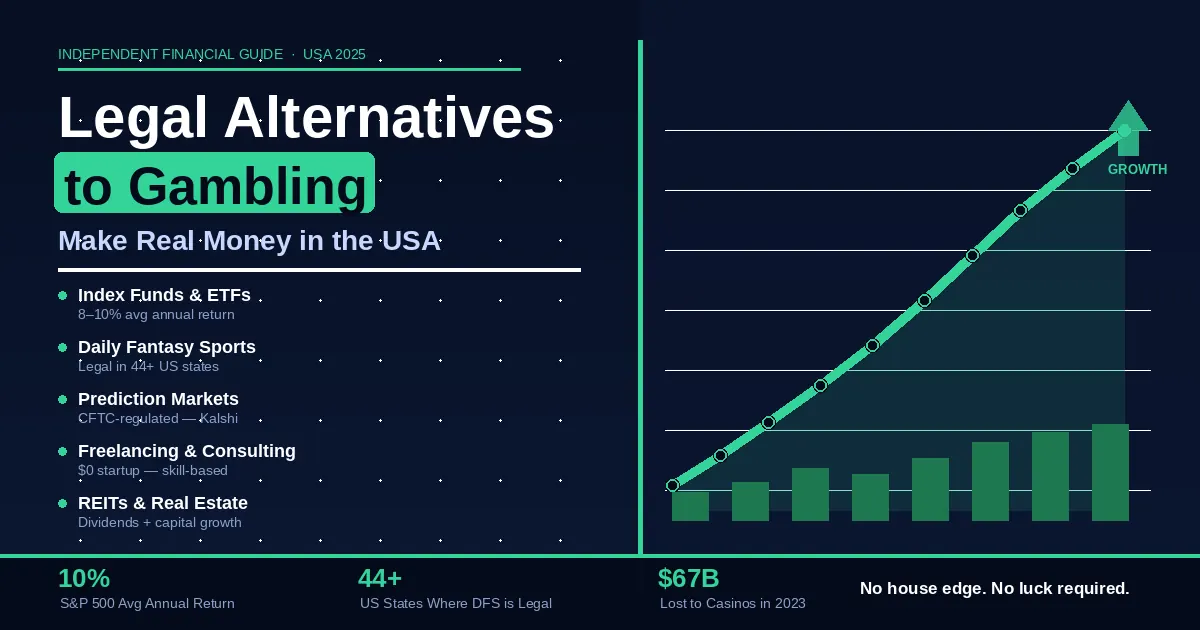
A common argument is that investing in stocks is “just another form of gambling,” but the underlying math is fundamentally different. The stock market has historically produced a positive expected return over long time horizons, while every standard casino game and lottery has a negative expected return built into its rules.
Buying a broad market index fund means owning a small share of real companies that, on average, grow earnings and pay dividends over time. That’s a positive-EV position, even though any single year can lose money due to short-term volatility. A roulette bet or lottery ticket carries no underlying asset and no long-term positive return; the payout structure is fixed against the player from the start.
The confusion usually comes from the fact that both involve risk and short-term uncertainty. Risk and negative expected value are not the same thing. Bonds, index funds, and even individual stocks involve risk with a historically positive long-term return, while casino games involve risk with a mathematically guaranteed negative return. Treating them as equivalent ignores the one number that actually decides the outcome: expected value.
How Casinos Use This Math to Design Every Game
Casinos don’t guess at house edge; they engineer it into every rule, paytable, and odds chart before a game ever reaches a floor. Game designers run the exact same expected value calculations covered above, then adjust payouts until the edge lands in a target range that’s profitable but still attractive enough for players to keep betting.
Regulators in most jurisdictions require casinos to publish or disclose theoretical RTP figures for slot machines, and licensed online platforms typically list these percentages in game information menus. A 94% RTP slot and a 98% RTP slot can sit side by side on a casino floor, both profitable for the house, just at different edge sizes.
Table games keep their edges lower than slots because they need a high volume of hands per hour to generate steady revenue, and players are more likely to notice an obviously unfair table game than a slot machine’s hidden math. Side bets on table games, like Perfect Pairs in blackjack or Fire Bet in craps, almost always carry a far higher house edge than the main wager, specifically because they’re optional add-ons rather than core gameplay.
Why Gambling Myths Keep People Betting Past the Math
Several common beliefs convince people they can outplay the house edge, and all of them collapse under basic probability. Recognizing these patterns is often more useful than memorizing formulas, because they explain the psychology that keeps people betting after the math has already turned against them.
The gambler’s fallacy. This is the belief that past results affect future independent events, like assuming a roulette wheel is “due” for black after five reds in a row. Each spin is statistically independent. The wheel has no memory, and the odds reset completely on every spin, with the same 5.26% edge applying regardless of recent history.
Chasing losses. After a losing session, many gamblers increase their bet size to “win back” what they lost. This doesn’t fix a negative EV game; it just exposes more money to the same losing edge, usually accelerating the loss rather than recovering it.
Survivorship bias in stories. Big jackpot winners get news coverage and word-of-mouth attention. The millions of players who lost steadily to fund that jackpot don’t make headlines, which skews public perception of the real odds toward rare, highly visible outcomes.
Confusing variance with skill. A short winning streak feels like proof of a system working. Variance, the natural swing of short-term results around the true average, can produce winning streaks even in a game with a stacked house edge. Over a large enough sample, variance shrinks and the edge takes over completely.
The near-miss effect. Slot machines are designed to show near-miss combinations, like two matching symbols and a third just one position away, far more often than pure random chance would produce. This pattern keeps players feeling close to a win without changing the actual payout odds.
“It’s only a small bet.” Frequency matters as much as bet size. A $5 bet repeated 200 times a month exposes the same total wagered amount as a single $1,000 bet, and the house edge applies to every dollar wagered, regardless of how it’s split up across a session.
Frequently Asked Questions
Can a skilled gambler beat the house edge long term? In games like blackjack, skilled card counters have occasionally shifted the edge in their favor, but casinos actively detect and ban this play. For nearly all games and nearly all players, the house edge holds regardless of skill level or experience.
Why do casinos let people win at all? Wins keep players engaged and betting, which generates more total wagers over time. Casinos profit from the house edge applied across millions of bets, not from any single outcome, so occasional wins don’t threaten their overall math.
Does betting bigger amounts change the odds? No. Bet size doesn’t change the probability or the house edge percentage. A $1,000 bet and a $10 bet both lose the same percentage on average; the larger bet simply risks more money to the identical edge.
Is online gambling math different from in-person gambling? The underlying math is the same. Online slots, roulette, and sportsbooks use the same probability and payout structures as physical venues, and licensed platforms publish or disclose their house edge or return-to-player percentages.
Can betting systems like Martingale actually work? Progressive betting systems change bet sizing patterns but cannot alter a game’s negative expected value. They can extend a winning streak or delay a loss, but mathematically they cannot turn a losing game into a winning one over time.
Why does it feel like I’m breaking even when I’m actually losing? Small, frequent wins create the feeling of breaking even, while losses often go unconsidered. Tracking total wagered versus total returned over time, not session by session, reveals the real result far more accurately.
What’s a practical first step if I want to cut back on gambling? Setting a strict, non-negotiable budget before you start, and stopping completely once it’s gone, removes the decision-making moment where chasing losses usually begins. Many people also find it helpful to track total spend weekly rather than per session.
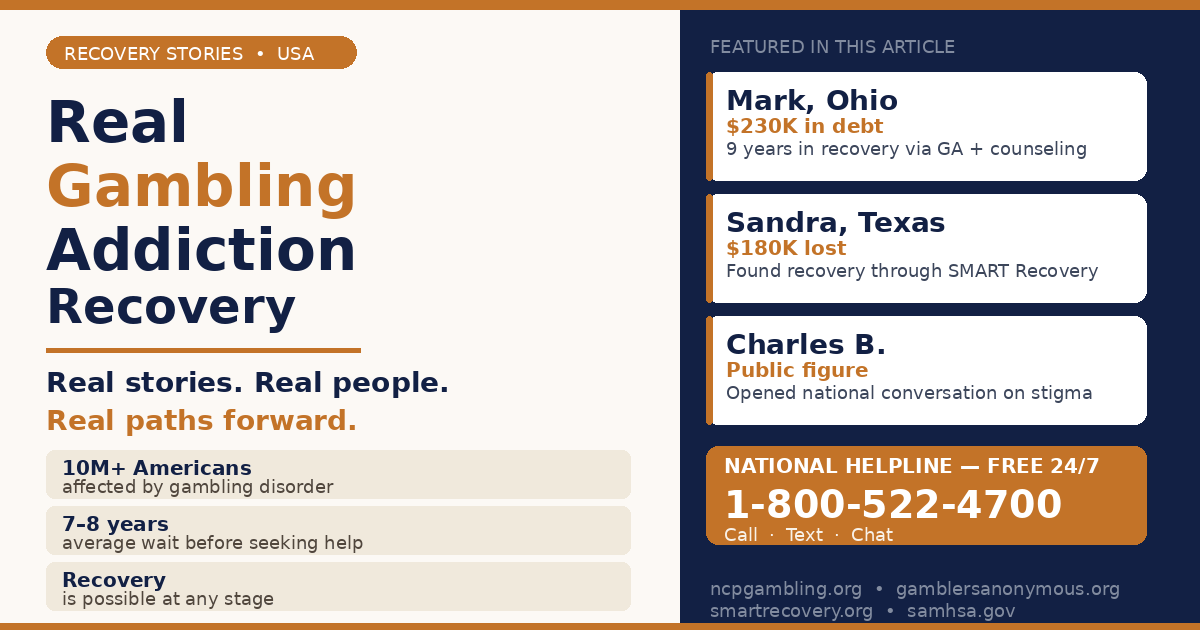
Where can someone get support for problem gambling? The National Council on Problem Gambling operates a free, confidential helpline at 1-800-522-4700, available 24/7 in the United States, along with text and chat support through their website.
Is gambling math the same as investing in the stock market? No. Index funds and broad market investing have historically carried a positive expected return over long periods, while standard casino games and lotteries have a fixed negative expected return built into their payout rules.
Can tracking results actually help someone gamble less? Yes. Writing down total amount wagered and total amount returned over weeks, rather than judging single sessions, turns an abstract house edge into a visible, personal number that’s harder to rationalize away.
The Bottom Line
The math behind gambling doesn’t leave room for a long-term winning strategy. House edge guarantees a statistical loss over time, expected value calculations confirm it bet by bet, and the games with the worst odds, like lotteries and keno, drain money fastest. Betting systems, hot streaks, and near-miss patterns feel meaningful in the moment, but none of them change the underlying probability.
If you’re trying to reduce or stop gambling, the numbers themselves are a useful anchor: no system beats a negative expected value, and every session is governed by the same fixed edge. Setting a firm budget before playing, tracking total spend over weeks rather than single sessions, and reaching out to a free resource like the National Council on Problem Gambling helpline (1-800-522-4700) are concrete next steps grounded in the same math this article just walked through.
None of this math requires a finance degree or a statistics course to apply in everyday decisions. The next time a bet, a slot pull, or a lottery ticket feels like a reasonable risk, running it through the same three questions covered here, what’s the house edge, what’s the expected value, and how many times would this bet need to repeat before the edge takes over, turns an emotional decision into a measurable one. That single habit, repeated consistently, does more to change long-term outcomes than any betting system ever could.
Discover useful tips, tricks, and solutions to your daily hurdles—dive into our resources today