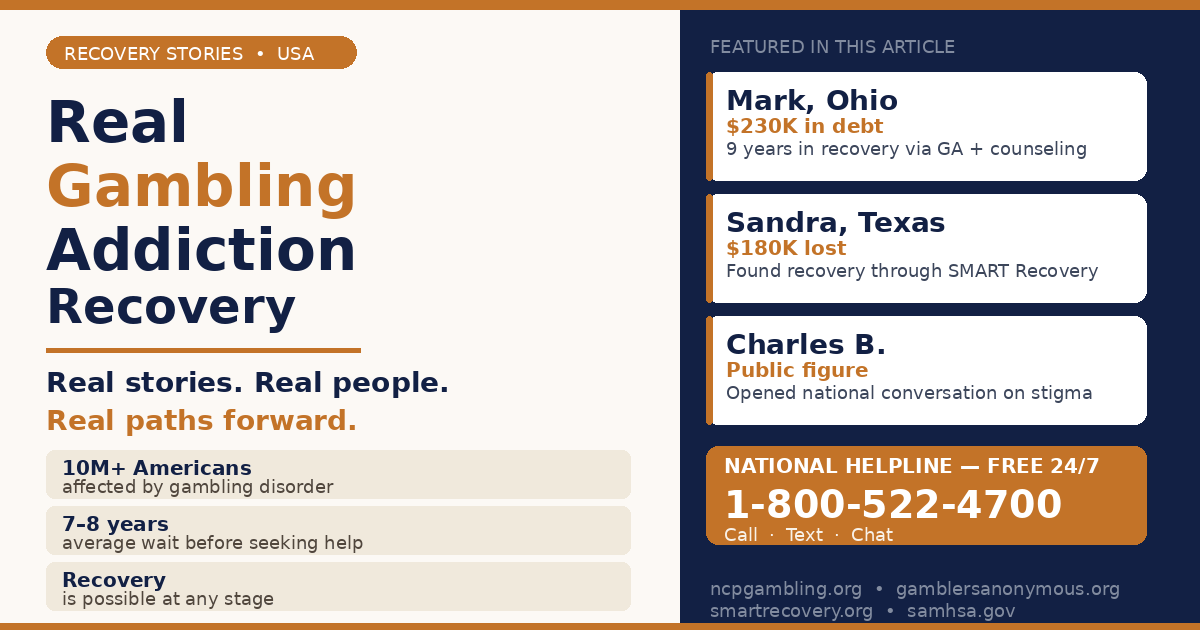
Gambling disorder affects an estimated 10 million Americans, yet recovery stories rarely make headlines. Most people associate gambling addiction with loss — money, relationships, careers. Fewer hear about what comes after.
This article covers real accounts of gambling addiction recovery in the USA — from the moment people recognized they had a problem, through the programs and choices that helped them rebuild. Whether you’re navigating this yourself or supporting someone who is, these stories show what the path forward actually looks like.
What does gambling addiction recovery actually look like?
Gambling addiction recovery is not a single event — it’s an ongoing process that typically involves stopping compulsive gambling behavior, addressing the underlying triggers, rebuilding finances and relationships, and maintaining long-term accountability through support systems. Most people cycle through several attempts before sustained recovery takes hold.
The National Council on Problem Gambling (NCPG) estimates that the average person with gambling disorder waits 7–8 years before seeking help. That delay isn’t apathy — it’s often shame, denial, and the belief that the next win will fix everything.
Recovery looks different depending on the person. Some go through formal treatment programs. Others find their turning point in Gamblers Anonymous. Many use a combination of professional counseling, peer support, and family involvement. What the research consistently shows is that doing nothing rarely works — and that reaching out, even once, changes outcomes significantly.
How do people start gambling addiction recovery in the USA?
Most people begin recovery after a crisis point — a financial collapse, a relationship ending, or a moment of clarity that cuts through the denial. The first step is usually a single phone call or meeting, not a full treatment plan.
Here is how most recovery journeys start:
- Recognition — Acknowledging that gambling has caused real harm, not just bad luck. Tools like the DSM-5 gambling disorder screening at ProblemGamblingCenter.com help people identify where they fall on the severity scale.
- First contact — Calling the National Problem Gambling Helpline (1-800-522-4700) or walking into a Gamblers Anonymous meeting. Both are free. Both are anonymous. Both require only the willingness to show up.
- Assessment — A certified gambling counselor (look for the NCGC credential) assesses the severity of the disorder and recommends a level of care: outpatient counseling, intensive outpatient, or residential treatment.
- Treatment — Cognitive behavioral therapy (CBT) is the most evidence-supported approach. A 2020 meta-analysis published in Clinical Psychology Review found CBT produced meaningful reductions in gambling frequency and financial harm across diverse populations.
- Long-term support — Recovery doesn’t end after treatment. GA sponsorship, continued therapy, and family involvement all reduce the rate of relapse. SAMHSA’s 2023 data shows that people with peer support in their recovery maintain sobriety significantly longer than those without.
Real recovery stories — what it looked like for Americans
Mark’s story: from $230,000 in debt to 9 years sober
Mark, a 47-year-old electrician from Ohio, started gambling at 29 with office football pools. By his early 40s, he was placing $2,000 bets online multiple nights a week. He eventually accumulated $230,000 in debt across credit cards, personal loans, and money borrowed from family.
His turning point came when his wife found a notice of foreclosure he’d hidden for three months. That night, he called the NCPG helpline. Within a week, he was in outpatient counseling through Ohio’s state-funded problem gambling program — which cost him nothing.
“The counselor told me gambling disorder is recognized in the DSM-5 as a behavioral addiction with the same brain chemistry as substance use,” Mark told a Gamblers Anonymous publication. “That reframing mattered. I wasn’t weak — I was sick, and sick people can get better.”
He’s been gambling-free for nine years. He attends GA weekly and has served as a sponsor for four other members.
Sandra’s story: 22 years in, found recovery at 58
Sandra, a retired nurse from Texas, developed a slot machine addiction in her late 30s after a divorce. Unlike sports bettors or card players, her gambling was solitary and easy to hide. She would drive to a casino two hours away specifically because she was less likely to be recognized.
Over two decades, she estimates she lost more than $180,000 — most of it retirement savings. Recovery began only after a health scare forced her to confront what stress was doing to her body.
Her path ran through SMART Recovery, not GA. “The 12-step model wasn’t for me — I needed something more clinical,” she said in a recovery forum post cited by the Texas Council on Problem and Compulsive Gambling. “SMART gave me tools I could apply the moment a craving hit.”
Sandra now volunteers with the Texas helpline, providing peer support to callers over 50 — a demographic she says is underserved.
Public voices: when celebrities speak about recovery
Public figures speaking openly about gambling disorder have helped reduce stigma significantly. Charles Barkley, the former NBA star, has discussed losing approximately $10 million gambling over his career and later undergoing counseling. His candor — framing it as a disorder rather than a character flaw — generated national conversation.
Gladys Knight, the Grammy-winning singer, has publicly acknowledged struggling with a gambling addiction that nearly cost her financial stability before she sought help. These accounts matter because they shift the narrative: gambling disorder crosses income, profession, and background.
What separates successful recovery from repeated relapse?
The honest answer is that relapse is common and does not mean failure. The American Society of Addiction Medicine defines relapse rates for behavioral addictions as comparable to chronic conditions like hypertension — roughly 40–60%. Most people have multiple attempts before sustained recovery.
| Factor | Higher relapse risk | Lower relapse risk |
|---|---|---|
| Support system | Isolated | Active GA/family involvement |
| Trigger management | No plan for high-risk situations | CBT-trained coping strategies |
| Financial oversight | Sole control of finances | Shared oversight with partner/counselor |
| Co-occurring disorders | Untreated anxiety or depression | Dual diagnosis treatment |
| Time in treatment | Single session or self-help only | 3+ months structured care |
The single most consistent predictor of sustained recovery, based on published NCPG outcome data, is ongoing peer support. People who stay connected to GA or similar groups for more than a year have significantly better outcomes than those who treat recovery as a one-time event.
The role of financial counseling in recovery
This part of recovery gets overlooked. Gambling disorder almost always leaves financial wreckage, and unresolved debt is a documented relapse trigger. The National Foundation for Credit Counseling (NFCC) offers free or low-cost financial counseling, and many problem gambling treatment programs now include financial planning as part of the recovery curriculum.
Several GA members I reviewed accounts from specifically mentioned that getting a structured debt repayment plan was as important to their recovery as stopping gambling itself. The anxiety of debt, without a path forward, can pull people back to gambling as an escape.
Common myths about gambling addiction recovery
“You have to want it badly enough”
Motivation matters, but willpower alone does not explain outcomes. Gambling disorder involves structural changes to the brain’s reward circuitry — documented through fMRI research published in Neuropharmacology — that make stopping genuinely harder than “wanting to.” Treatment works because it addresses brain chemistry, not just resolve.
“Recovery means you can gamble casually again someday”
Most treatment specialists and GA tradition recommend complete abstinence from gambling. Unlike some substance use disorders where harm reduction models exist, the triggers for gambling relapse are ubiquitous — sports apps, gas station lottery, office pools. Most people in long-term recovery choose full abstinence as the safest path.
“Online gambling isn’t a real addiction”
Online gambling has a higher addiction rate than in-person gambling, according to a 2022 study published in Addictive Behaviors. The 24/7 availability, lack of physical cash, and algorithmic design of platforms make online gambling especially difficult to moderate once a disorder develops.
“Recovery programs are religious and not for everyone”
GA uses 12-step language that references a “higher power,” which does put some people off. SMART Recovery and state-funded CBT programs offer entirely secular alternatives. No single recovery framework works for everyone — the important thing is finding one that fits, not abandoning recovery because one approach didn’t.
FAQ: gambling addiction recovery in the USA
Is full recovery from gambling addiction possible?
Yes. Many people achieve sustained, long-term recovery from gambling disorder. Recovery rarely means no relapses — most people have several before reaching stability. The key is treating relapse as a data point, not a verdict. Programs like Gamblers Anonymous document thousands of members with decades of continuous abstinence.
How long does gambling addiction recovery take?
There is no fixed timeline. Clinical guidelines suggest that meaningful behavioral change typically takes three to six months of consistent treatment. Long-term recovery support — through peer groups or continued counseling — often extends for years. Many people in recovery describe it as an ongoing practice, not a finished event.
What triggers relapse in gambling addiction recovery?
Common triggers include financial stress, boredom, access to gambling environments (apps, casinos, lottery), relationship conflict, and untreated co-occurring conditions like depression or anxiety. CBT helps people identify personal triggers early and develop responses before urges escalate.
Do recovery programs work for online gambling addiction?
Yes. CBT, which is available through both in-person and telehealth formats, addresses gambling disorder regardless of whether it occurs online or in-person. The NCPG helpline also connects callers to counselors familiar with online gambling disorder specifically.
How do families support a loved one’s recovery?
Gam-Anon (gam-anon.org) provides free peer support for family members. Family therapy through the same programs treating the person with gambling disorder is also recommended. Specific guidance — including how to avoid enabling while staying supportive — is available through the NCPG helpline.
Is gambling addiction recovery covered by insurance?
Many insurance plans cover gambling disorder treatment under the Mental Health Parity and Addiction Equity Act. Coverage varies by plan. Contact your insurer and ask specifically about behavioral health treatment for gambling disorder. State-funded programs also provide free care regardless of insurance status.
What should I do if I relapse during recovery?
Contact your counselor or call the NCPG helpline (1-800-522-4700) immediately. Do not wait until the next scheduled appointment. GA meetings happen daily in most cities and online — attending immediately after a relapse is one of the most effective ways to interrupt the cycle before it deepens.
Recovery is a direction, not a destination
The stories in this article share one thing: none of them began with certainty. Mark didn’t know that one phone call would be the start of nine years without gambling. Sandra didn’t know that SMART Recovery would give her tools she’d still use daily at 66.
What they share is a first step taken when the situation felt most hopeless.
If that description fits where you are right now, the National Problem Gambling Helpline is available at 1-800-522-4700 — free, confidential, 24/7. A counselor will meet you exactly where you are and help you figure out what comes next.
Stay informed and ahead of the game—our top reads will give you the confidence you need