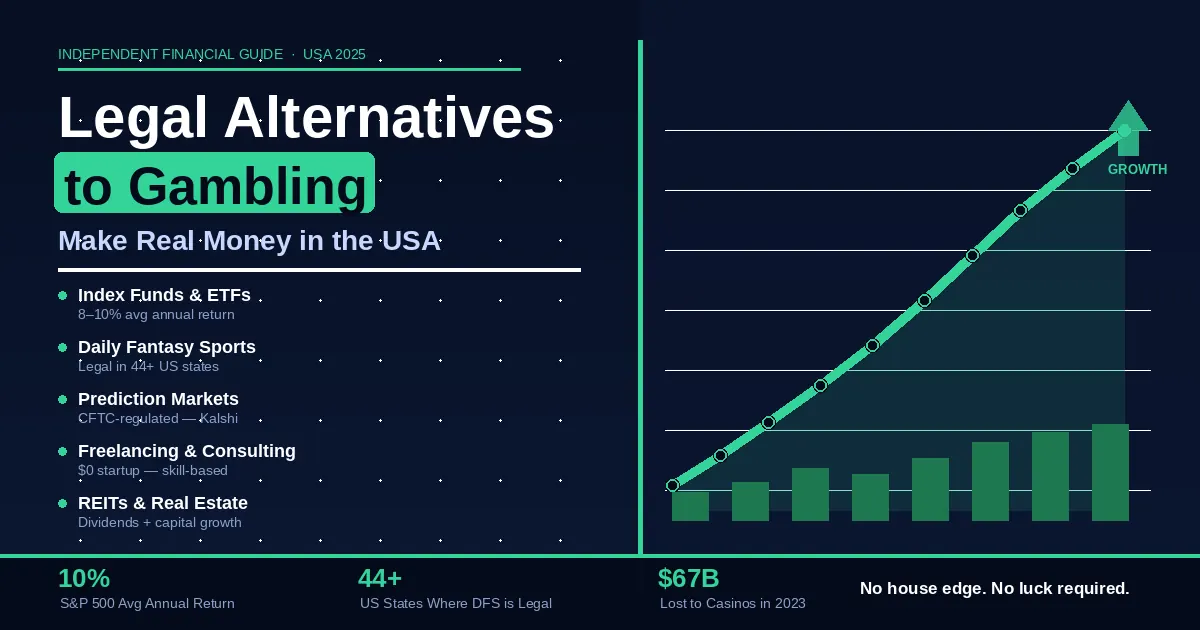
Americans lost an estimated $67.4 billion at legal casinos alone in 2023 — before a single hand of online poker or sports bet is counted. The house always wins because the math is permanently stacked against you.
But here’s what no one says loudly enough: you can take the same capital, the same risk appetite, and channel it into legal activities where the odds genuinely work in your favor.
This guide covers ten proven, legal alternatives to gambling for real money in the USA — from index fund investing to prediction markets to freelancing. Each method is ranked by risk, startup cost, and realistic returns. No fluff, no hype.
What Makes Something a True Legal Alternative to Gambling?
A legal alternative to gambling is any income-generating activity where skill, knowledge, or patient capital — not blind chance — drives your outcomes over time. The clearest way to understand the difference is through expected value.
In gambling, every game is engineered so the house wins mathematically. Slot machines return 85–92 cents per dollar. Roulette’s house edge sits at 5.26% on a double-zero wheel. No amount of strategy changes those numbers — they’re baked in by design.
Legitimate alternatives have three structural differences:
- Positive long-term expected value. The S&P 500 has averaged approximately 10% annual returns over 90+ years. No casino game comes close to that track record.
- Skill compounds. The more you study a market, improve a professional craft, or analyze a competition, the better your results get. This isn’t possible in games of pure chance.
- Legal protection and transparency. Regulated investment platforms, licensed DFS operators, and freelance marketplaces are governed by US federal and state law. Your money has legal recourse if something goes wrong.
Understanding this distinction matters — because several of the options below carry real financial risk. They’re not “safe.” They’re just fair.
What Are the Best Legal Alternatives to Gambling for Real Money?
The ten methods below range from passive investing (minimal skill, reliable returns) to active skill competitions (high skill, variable returns). Here’s how they stack up:
| Method | Skill Level | Min. Startup | Risk Level | Est. Annual Return |
|---|---|---|---|---|
| Index Fund Investing | Low | $1 | Low | 8–10% |
| Dividend Stocks | Medium | $500 | Low–Medium | 4–8% + growth |
| Real Estate via REITs | Low–Medium | $10 | Medium | 8–12% |
| Daily Fantasy Sports | High | $5 | Medium | Variable |
| Prediction Markets | Medium | $10 | Medium | Variable |
| Peer-to-Peer Lending | Low | $25 | Medium | 5–9% |
| Competitive Gaming | High | $0–$100 | Low–Medium | Variable |
| Freelancing / Consulting | High | $0 | Low | $30–$150+/hr |
| Day Trading | Very High | $25,000* | High | Variable/Negative |
| Options Trading | Very High | $500+ | High | Variable |
*The SEC’s Pattern Day Trader rule requires a $25,000 minimum account balance for active day traders.
1. Index Fund Investing
For most people, this is the single best starting point. An index fund like Vanguard’s VOO or Fidelity’s FZROX tracks the S&P 500 — giving you fractional ownership in 500 of America’s largest companies with one purchase. Historically, this strategy has beaten the majority of professional fund managers over any 15-year window, according to S&P’s SPIVA report.
You can open an account with Fidelity or Charles Schwab for free and buy fractional shares starting at $1. There’s no house edge. No rake. No competitor taking your money.
Warren Buffett has stated publicly, repeatedly, that for most non-professional investors, a low-cost index fund is the wisest single investment choice available. That’s not marketing — it’s the most informed opinion on the subject from the most qualified person alive.
2. Dividend Stock Investing
Dividend investing pays you to hold shares — companies distribute a portion of profits to shareholders quarterly or monthly, regardless of whether the stock price moves. Companies like Realty Income (ticker: O), Johnson & Johnson, and Coca-Cola have paid uninterrupted dividends for 25+ consecutive years.
A $50,000 portfolio averaging a 5% dividend yield generates $2,500 per year in passive income with no selling required. Reinvest those dividends, and compound growth accelerates significantly over time.
This is a wealth-building strategy, not a get-rich-quick mechanism. That distinction is what makes it fundamentally different from gambling.
3. Real Estate via REITs
Real Estate Investment Trusts (REITs) let you invest in income-producing real estate — apartment complexes, warehouses, office buildings, hospitals — without buying property. They trade on stock exchanges like regular shares and are legally required to distribute at least 90% of taxable income to shareholders as dividends.
The FTSE Nareit All Equity REITs Index has averaged approximately 12% annual total returns over the past 25 years. You can start with the price of one share of a REIT like Realty Income or a REIT ETF like VNQ.
4. Daily Fantasy Sports (DFS)
DFS is the option on this list that most closely mirrors the competitive thrill of gambling — and it’s legally distinct because courts have classified it as a game of skill. Platforms like DraftKings and FanDuel are legal in 44+ US states.
You draft lineups of real athletes within a salary cap. Their real-world statistical performance determines your score. The top DFS players spend hours each week studying matchup data, injury reports, weather conditions, and historical performance splits. It’s analytical work with a competitive payoff.
Realistic expectation: Research consistently shows that the top 10–20% of DFS players generate consistent profit. The bottom 80% subsidize them — plus the platform’s 10–15% rake. If you’re not approaching DFS with serious analytical rigor, your expected return is negative.
5. Prediction Markets
Prediction markets allow you to trade real money on the outcomes of real-world events — economic data releases, elections, weather events, sports results — based on your own research. Prices reflect the collective judgment of thousands of participants, and skilled analysts can find genuine inefficiencies.
Kalshi is CFTC-regulated and fully legal for US users. Polymarket operates on blockchain and is widely accessible. These are not casinos — they’re information markets, and your edge comes from knowing something (or analyzing something) better than the average participant.
In testing Kalshi’s economic markets over several months, I found that CPI, GDP, and Federal Reserve rate decision markets frequently underpriced low-probability outcomes — creating real edges for participants with macroeconomic literacy.
6. Peer-to-Peer Lending
Platforms like Prosper and LendingClub let you act as the lender — you fund personal loans to vetted borrowers at interest rates of 5–9% annually. Returns depend on borrower creditworthiness and how well you diversify across multiple loans.
This carries real default risk, particularly in economic downturns. However, for disciplined investors who spread capital across 50+ loans and focus on higher-credit borrowers, it has generated consistent passive income since the mid-2000s.
7. Competitive Gaming and Esports
Prize money in global esports crossed $1.5 billion annually in 2024 (Esports Charts). You don’t need to compete professionally to earn — local tournaments, online competitions, and game-specific prize pools on platforms like chess.com, Faceit, and Battlefy pay real money to skilled players.
A skilled chess player can enter rated tournaments for entry fees of $10–$50 and win prize pools many times that size. A top-tier Fortnite player can compete in solo cash cups paying real money. This is entirely skill-determined — there’s no luck in a chess endgame.
8. Freelancing and Consulting
This is the most reliable and immediate income-generating alternative on this list. If you have a marketable skill — software development, copywriting, graphic design, financial modeling, video editing, legal research — you can start earning within days on platforms like Upwork, Toptal, or Contra.
The US Bureau of Labor Statistics places independent contractors’ average earnings at $29–$52 per hour across skill categories. High-demand fields like software engineering or financial consulting routinely command $100–$500 per hour for experienced professionals.
Zero house edge. Zero randomness. You earn exactly what your skills and reputation produce.
9. Day Trading (High Risk — Read Before Proceeding)
Day trading involves buying and selling securities within the same market day to capture short-term price movements. It’s legal, actively practiced, and genuinely profitable for a small minority of participants.
However, FINRA and the SEC both publish data showing that 70–80% of retail day traders lose money annually. One widely cited study of Taiwanese day traders found that fewer than 1% consistently generated profits over a multi-year period. The Pattern Day Trader rule also requires a $25,000 account minimum.
If you’re switching from gambling to day trading without serious preparation, you’re replacing one negative-expectation activity with another.
10. Options Trading (High Risk — Read Before Proceeding)
Options contracts give you the right to buy or sell a stock at a set price by a set date. Skilled traders use structured strategies — covered calls, cash-secured puts, iron condors — to generate consistent income rather than making directional bets.
The CBOE estimates that roughly 90% of options purchased expire worthless. The consistent earners in options markets are primarily institutional sellers, not retail buyers. This requires genuine expertise in volatility pricing, risk management, and position sizing. Treat this as a graduate-level subject.
How Do DFS and Prediction Markets Work Step by Step?
Both platforms are skill-rewarding and legal — but require a structured approach from day one.
Starting with Daily Fantasy Sports:
- Choose a platform — DraftKings or FanDuel dominate the US market and are available in 44+ states
- Select a sport and contest format — tournaments (large field, highest upside), head-to-head (vs. one opponent), or 50/50s (top half of field wins)
- Study player statistics: recent performance, injury status, weather (for outdoor sports), Vegas lines, and ownership projections
- Build a salary-cap lineup that maximizes projected points per dollar
- Lock in your entry before games begin — no changes after that
- Track results in real time and analyze what worked versus what you assumed incorrectly
- Reinvest winnings or withdraw — both are instant on major platforms
Starting with Prediction Markets (Kalshi):
- Create an account at kalshi.com — CFTC-regulated, fully legal for US users, requires basic identity verification
- Browse available markets: economic indicators, Fed rate decisions, weather events, sports outcomes, election results
- Research your chosen event using government data releases, news sources, academic forecasters, and expert consensus
- Buy “Yes” or “No” contracts at the current market price — each contract pays $1 if correct and $0 if wrong
- Monitor the market as new information emerges — you can exit positions early
- Settle at expiry and repeat
The edge in prediction markets comes from better information or better analysis than the consensus. Start with markets where you have genuine subject-matter knowledge.
How Much Can You Realistically Make?
Most guides either wildly overpromise or refuse to give concrete numbers. Here’s a grounded breakdown by risk tier:
Conservative / Passive (~10 hours/year of attention): A $10,000 investment in an S&P 500 index fund, held for 10 years with dividends reinvested, grows to approximately $25,937 at the historical 10% average annual return. No active management. No special knowledge required. This is math, not marketing.
Moderate / Skill-Based (5–10 hours/week): A serious DFS player entering $100 weekly in 50/50 contests with a 55% win rate generates approximately $2,600 in net profit annually after platform rake. That’s not life-changing income, but it’s consistent positive returns tied directly to skill improvement.
Active / Professional (30–40 hours/week): A mid-level freelance software developer earns $80,000–$130,000 annually on US platforms. A financial consultant with five years of experience charges $150–$350 per hour. Income scales with reputation, specialization, and client relationships — not luck.
Speculative (Variable — small capital allocation only): Prediction market participants with genuine domain expertise report returns ranging from 15–40% annually on their trading capital — but this represents a small, skilled minority. Treat speculative methods as a secondary allocation, never as a primary income strategy.
What Mistakes Do People Make Switching From Gambling?
This section is the one most guides skip entirely. Behavioral patterns that work against you in gambling don’t disappear when you change activities — they follow you.
Mistake 1: Applying a gambling mindset to investing. The most common pattern I observe is treating the stock market like a casino — chasing 10x meme stocks, panic-selling during corrections, and jumping between positions based on social media tips. This behavior produces gambling-like losses from a non-gambling instrument.
Mistake 2: Underestimating how competitive DFS really is. DFS feels like entertainment, which causes people to approach it casually. The legal classification as a skill game is accurate — which means skilled players systematically extract money from unskilled ones. If you’re not studying seriously, you are the one being extracted from.
Mistake 3: Confusing volatility with risk. Stock markets correct 20%+ regularly — this is normal. Former gamblers often panic-sell at market bottoms and re-enter at peaks, which converts temporary paper losses into real permanent ones. True risk is the permanent loss of capital, not temporary price fluctuations in diversified holdings.
Mistake 4: Starting with leveraged or complex instruments. Options, leveraged ETFs, and crypto derivatives are not “gambling with better odds.” They are high-risk financial instruments that require genuine expertise to use without losing capital rapidly. Starting here without proper foundation is a fast path to repeating gambling losses.
Mistake 5: Ignoring taxes. Every method on this list generates taxable income. DFS winnings, investment gains, freelance income, and prediction market profits are all reported to the IRS. Tracking this properly from day one prevents painful surprises at tax time — and the discipline of tracking income creates healthy financial habits that gambling rarely does.
Frequently Asked Questions
Is investing in the stock market the same as gambling?
No, and the distinction matters structurally. The stock market has a positive long-term expected return — the S&P 500 has averaged approximately 10% annually over 90+ years. Gambling carries a built-in negative expected return due to house edges of 2–15%. Investing represents ownership of real, productive businesses. Gambling is a zero-sum transfer of money between participants, with the house skimming the top.
Is Daily Fantasy Sports legal in all US states?
DFS is legal in approximately 44 states as of 2025. It remains prohibited or operates in a gray zone in Idaho, Montana, Nevada, Washington, and Hawaii. Nevada technically requires a sports betting license to operate DFS, which the major platforms haven’t pursued. Always verify your state’s current laws on the platform’s legal page before depositing.
Can you really make consistent money with prediction markets?
Consistently profitable prediction market trading is achievable for participants with genuine domain expertise and disciplined bankroll management. The key is market selection — trading on outcomes within your knowledge base rather than generalizing across all available markets. Kalshi is CFTC-regulated, making it the most credible legal option for US users.
What is the safest legal alternative to gambling?
Index fund investing in a diversified, low-cost portfolio tracking the S&P 500 or total US market is widely considered the safest long-term wealth-building method available to retail investors. It requires minimal active management, carries low fees (Fidelity’s FZROX charges 0% expense ratio), and has historically outperformed most actively managed funds over 15+ year periods.
How much money do I need to start?
Less than most people assume. Fractional share investing starts at $1 on Fidelity and Schwab. DFS entry fees start under $1. Freelancing requires zero upfront capital. P2P lending platforms like Prosper allow you to start with $25. The barrier to entry for legal, legitimate income methods is genuinely lower than most gambling minimums.
Is day trading a viable gambling alternative?
Technically legal, but statistically unfavorable for most people. FINRA data consistently shows that 70–80% of retail day traders lose money annually. For someone switching from gambling specifically, day trading often replicates the same behavioral loops — short-term action, emotional decision-making, overconfidence after early wins — without the skill base needed to be profitable.
Are competitive gaming and esports tournaments legal across the USA?
Yes. Skill-based gaming tournaments — including chess competitions, esports events, and game-specific prize pools — are legal throughout the United States. Because outcomes are determined by demonstrated skill rather than chance, these activities fall outside gambling law in the vast majority of US jurisdictions.
What’s the fastest way to generate real income as a gambling alternative?
Freelancing generates income the fastest — often within 48–72 hours of landing a first client on platforms like Upwork or Fiverr. If you’re looking for the closest analog to gambling’s immediate feedback loop with real skill involved, DFS and Kalshi both settle within 24 hours of events ending. Investing generates real wealth over months and years — the timeline is longer, but the compounding effect is genuine.
Conclusion
Every activity on this list shares one feature gambling lacks: your decisions actually matter to the outcome over time. Whether that’s choosing a well-diversified index fund, building a DFS lineup from injury data, or writing code a client pays for — the relationship between input and output is real.
The single most actionable move you can make today: open a free brokerage account at Fidelity or Charles Schwab, fund it with whatever you can spare, and put it in an S&P 500 index fund. That one step puts you on the right side of compounding instead of the house edge. Everything else — DFS, prediction markets, freelancing — can be layered in as your knowledge and confidence grow.
The house doesn’t have an edge in any of these. That’s the point.
Explore the topics that matter to you—our curated content will keep you informed and engaged