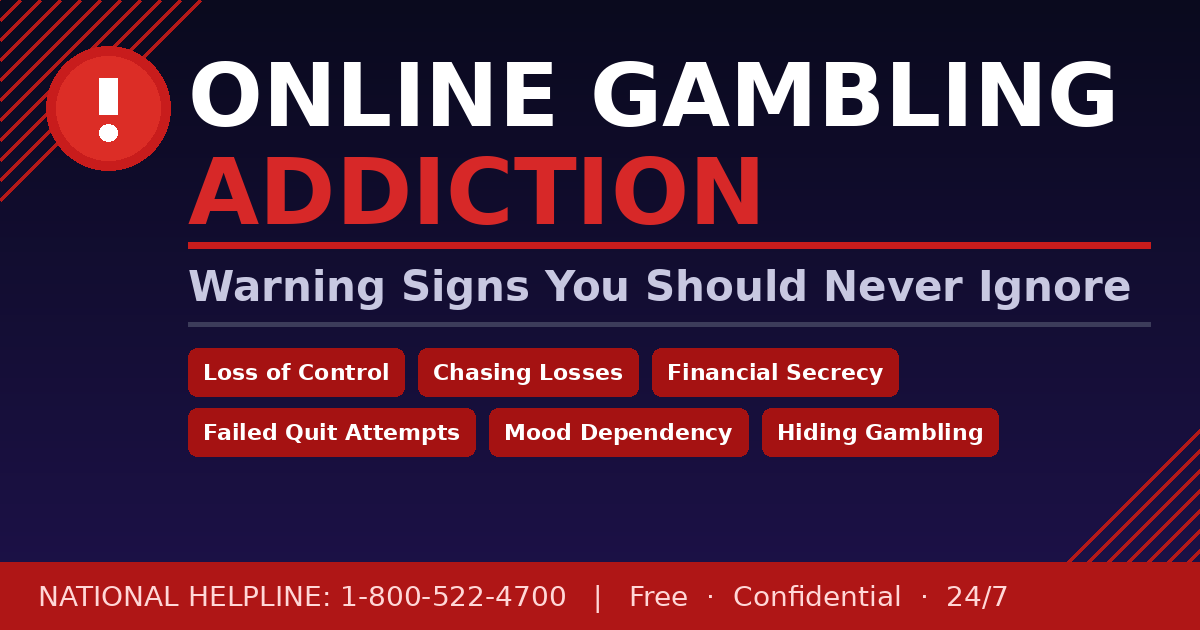
Online gambling addiction builds quietly. One late session becomes a habit, one hidden loss becomes a pattern, and by the time the damage is visible, the behavior is already ingrained.
Unlike alcohol or drugs, problem gambling leaves no physical trace. That invisibility is exactly what makes it dangerous. The warning signs are behavioral and financial — and they are easy to rationalize until they aren’t.
This article covers the real, clinically recognized warning signs of online gambling addiction, what separates compulsive gambling from recreational betting, and what actually works when someone is ready to get help.
What Is Online Gambling Addiction?
Online gambling addiction is a compulsive behavioral disorder in which a person cannot stop gambling despite clear negative consequences to their finances, relationships, or mental health. The American Psychiatric Association formally classifies it as Gambling Disorder in the DSM-5 — the only behavioral addiction given full diagnostic status alongside substance use disorders.
The shift from physical casinos to smartphones changed the scale of the problem. A 2023 report from the National Council on Problem Gambling found that 2–3% of Americans meet the clinical criteria for gambling disorder, with online platforms accounting for a growing share of new cases. Access is instant. Losses feel abstract on a screen. And the psychological hooks built into online platforms — variable reward schedules, near-miss mechanics, deposit bonuses — are not accidents. They are deliberate design choices.
The defining question is never how often someone gambles. It is whether they can stop.
What Are the Warning Signs of Online Gambling Addiction?
The core warning signs of online gambling addiction fall into four categories: behavioral changes, financial red flags, emotional patterns, and failed attempts to quit. Any one sign warrants attention. Several together signal a serious problem.
These are not hypothetical markers. They are the criteria clinicians use during assessment:
1. Gambling longer than planned — repeatedly
Logging in for twenty minutes and ending up hours later is not a time management issue. It is a loss of control over the behavior, which is the defining feature of any addiction diagnosis.
2. Hiding gambling from family or friends
Deleting browser history, using a separate device, or creating cover stories for missing money means shame and compulsion have already taken hold. Secrecy is almost always present before the financial damage becomes obvious.
3. Chasing losses
Returning to gamble specifically to recover what was just lost — “I just need to win it back” — is called loss-chasing. A 2021 study published in Addictive Behaviors found that loss-chasing is one of the strongest behavioral predictors of gambling disorder severity, more reliable than time spent or money lost.
4. Neglecting real-world responsibilities
Missing work deadlines, skipping family commitments, or staying awake through the night to gamble shows that online betting has started displacing actual priorities. This is typically when people around the person first notice something is wrong.
5. Borrowing money, selling possessions, or maxing credit cards
Financial desperation — taking payday loans, liquidating savings without explanation, borrowing from multiple people — marks a later but still-reversible stage of the addiction. Many people at this point maintain that they are “just going through a rough patch.”
6. Mood tied to gambling results
Irritability, anxiety, or depression that tracks directly with recent wins or losses means the person’s emotional regulation has become dependent on gambling outcomes. This is a clinical warning sign, not a personality quirk.
7. Gambling to escape or numb
Using online slots or poker to manage stress, avoid difficult feelings, or fill boredom is qualitatively different from recreational gambling. The National Problem Gambling Helpline reports that escape-motivated gambling is one of the most common patterns described by callers seeking help.
8. Multiple failed attempts to quit
Trying to cut back or stop, followed by relapse, is not a character flaw. It maps directly onto the DSM-5 diagnostic criteria for Gambling Disorder. It also signals that willpower-only approaches are unlikely to work long-term.
How Is Online Gambling Addiction Different From Normal Betting?
The difference between recreational gambling and a gambling disorder is not frequency or dollar amount — it is control and consequences. A recreational gambler can stop. A person with a gambling disorder cannot, even when the cost is clear.
| Factor | Recreational Gambler | Problem Gambler |
|---|---|---|
| Spending | Fixed budget, stops when hit | Consistently exceeds budget |
| Emotional state | Stable; gambling is entertainment | Anxious or irritable without it |
| Honesty | Open about gambling activity | Hides it from family or friends |
| Response to losses | Accepts and moves on | Chases losses to “get even” |
| Ability to stop | Can stop anytime | Struggles or fails repeatedly |
| Financial impact | Stays within personal means | Debt, borrowing, financial secrecy |
A recreational gambler loses $200 on a Saturday and doesn’t think about it Monday. A person developing an addiction loses that $200, deposits $400 more trying to recover it, hides the transaction, and lies awake planning the next session.
The size of the loss is less diagnostic than what happens after it.
What Makes Online Gambling More Addictive Than Physical Casinos?
Several features built into online gambling platforms accelerate addiction risk compared to traditional casinos. Understanding them explains why the same person who gambled moderately for years can lose control quickly after switching to apps or websites.
24/7 availability with no friction. A physical casino requires a trip, parking, and cash. An online casino requires one tap. Dr. Timothy Fong, a psychiatry professor at UCLA who specializes in behavioral addictions, has noted publicly that constant accessibility removes the natural friction that regulates behavior in other contexts.
Deposit bonuses and “free” credits. Welcome bonuses and reload offers create artificial early wins. This conditions the brain to associate the platform with reward before any real financial risk has been taken — a textbook setup for conditioned behavior.
Faster play cycles. Online slot machines can run through hundreds of spins per hour. That speed dramatically compresses the conditioning cycle that, in a physical casino, might unfold over hours.
Loss of real-money context. Credit-based systems in online casinos abstract the actual money being spent. Losing $100 in digital chips feels psychologically different from handing over $100 in cash, and the platforms are designed to exploit that gap.
Isolation. Physical casinos have social environments that create informal limits. A friend who says “okay, let’s go” is a natural brake. Online gambling is typically done alone, removing that external check entirely.
Common Myths About Online Gambling Addiction
Myth: You can’t be addicted if you haven’t lost that much money.
Gambling disorder is diagnosed on behavioral control, not on dollar amounts. Significant psychological dependency can develop before any serious financial damage appears. Waiting for things to “get bad enough” before seeking help delays treatment to a point where consequences are harder to reverse.
Myth: Problem gamblers gamble every single day.
Many people with gambling disorder cycle through intense binges followed by periods of abstinence. The binge-abstain pattern is common and makes the problem look intermittent or “not that serious” from the outside. The absence of daily gambling does not rule out addiction.
Myth: It’s a willpower problem.
Gambling addiction alters brain chemistry. Dopamine reward pathways are affected in ways that parallel substance addiction. Research published in the Journal of Gambling Studies shows that cognitive-behavioral therapy combined with peer support produces significantly better outcomes than willpower-based efforts to quit alone.
Myth: High earners aren’t at risk.
Gambling disorder cuts across income levels, education, and professional status. People with higher incomes often have access to more credit, which can actually prolong the addiction by delaying the financial consequences that might otherwise force them to confront the behavior.
Myth: Gambling apps are just entertainment, like mobile games.
Mobile gambling apps are classified separately from mobile games precisely because they involve real monetary stakes and probability mechanics. The dopamine response to near-misses in gambling is neurologically distinct from — and more intense than — what typical mobile gaming produces.
Frequently Asked Questions
How do I know if I have a gambling addiction? The clearest indicators are loss of control over stopping, hiding gambling activity from others, and continuing despite clear financial or relationship consequences. If you have tried to cut back or quit more than once and couldn’t sustain it, that pattern meets the clinical definition of Gambling Disorder. A licensed therapist can provide a formal assessment.
Can online gambling addiction be treated? Yes. Cognitive-behavioral therapy is the most evidence-supported treatment. The National Problem Gambling Helpline (1-800-522-4700) connects callers with trained counselors in every U.S. state. Gamblers Anonymous, platform self-exclusion programs, and financial counseling are also well-documented supports that work alongside therapy.
How long does treatment take? It varies depending on severity and whether co-occurring conditions like depression or anxiety are present. Some people stabilize within weeks through structured outpatient therapy. Others benefit from longer-term support. Relapse is common and does not mean treatment has failed — the goal is to shorten recovery time after each setback.
Is online gambling addiction the same as gaming addiction? They share behavioral patterns — compulsive use, loss of control, neglect of responsibilities — but gambling addiction involves real financial stakes and monetary reward systems that produce more intense dopamine responses. The DSM-5 formally classifies Gambling Disorder. Gaming disorder is recognized by the World Health Organization but not yet by the American Psychiatric Association.
What should I do if a family member is addicted to online gambling? Avoid covering their debts, which removes natural consequences and enables continued gambling. Gam-Anon is a peer support organization specifically for family members of people with gambling problems. A licensed addiction counselor can help you plan a structured, non-confrontational conversation that increases the chance of the person accepting help.
Can someone relapse after quitting? Yes, and it is more common than not. Triggers — financial stress, boredom, relationship conflict — can pull people back months or years into recovery. Relapse does not erase progress. The goal is to identify what triggered it, shorten the episode, and return to recovery faster than the last time.
Are certain people more at risk? Research consistently identifies higher risk among people with depression, anxiety, ADHD, or a family history of addiction. Young adults and adolescents are disproportionately represented in problem gambling statistics, partly due to early exposure to mobile apps and sports betting platforms. Men are statistically more likely to develop gambling disorder, though the gender gap is narrowing as more women use online platforms.
What is self-exclusion and does it work? Self-exclusion is a voluntary program offered by licensed gambling operators that allows users to block themselves from accessing a platform for a set period. It is not foolproof — motivated individuals can find workarounds — but research shows it reduces gambling frequency and financial harm for many participants, especially when combined with therapy.
Conclusion
Online gambling addiction rarely announces itself loudly. It starts with rationalization — “I’m just having fun,” “I’ll stop after this one,” “I’ll win it back.” By the time the pattern is undeniable, the financial and emotional damage is often significant.
The warning signs covered here appear long before rock bottom. Recognizing them early — loss of control, hidden behavior, chasing losses, mood dependency, failed attempts to quit — is the single most effective thing you or someone you care about can do.
If any part of this article felt personally relevant, the National Problem Gambling Helpline is available 24 hours a day at 1-800-522-4700. It is free and confidential. Getting help earlier is always better than waiting.
Looking for clarity? Find it in our handpicked articles packed with practical wisdom